Did you know: more people are diagnosed with a rare disease than with any one disease?
One such rare disease has hit home hard for a family with ties to Gregory County. Jean Ann Bryan, of Tea, SD, is the daughter of Jim and Donette Lyon of Herrick, owners of Herrick Honey Farms.
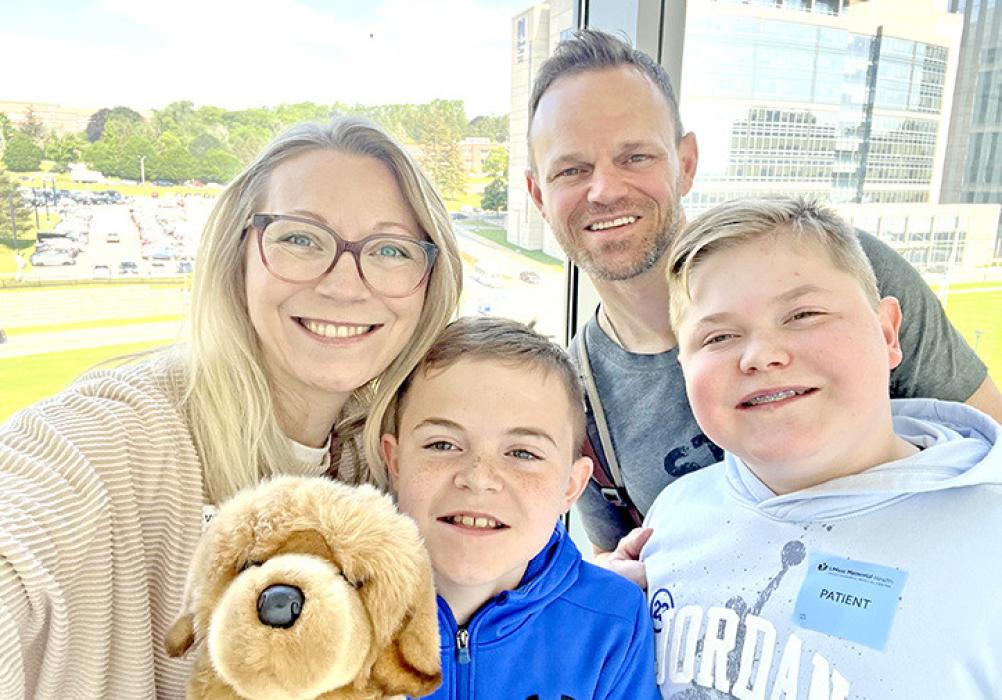
In 2019, Jean Ann and her husband Beau noticed their son, 8-year-old Sawyer, had an awkward run as they watched him in little league soccer. After consulting a physician, they tried physical therapy, thinking core strengthening would lead to improvement.
After a couple months, however, the doctor recommended testing to see if something else was going on. In November, the results showed that Sawyer has Duchenne muscular dystrophy (DMD), a fatal genetic disorder that affects one in every 3,500 male births. Most boys do not survive their mid-twenties.
Jean Ann explained that this was a total surprise. “...typically you would know of people in your family that have it and know that it is a risk, but it was not in our family.”
But this disorder was passed down genetically, it was caused by a random fluke.
“It came down to it being a germ line mosaic,” Beau elaborated. “Basically neither parent is carrying the cells that ultimately generated a muscular dystrophy diagnosis in our children. It would be the cells within the mother’s eggs that duplicated this error. Any children we had would have the exact same muscular dystrophy error.”
This means that Wesley, Sawyer’s younger brother has Duchenne muscular dystrophy also.
Having one child with a fatal disease is hard enough. Having both of your children with the same disease is almost too much.
Rather than dwell on the cards they had been dealt, the Bryans poured themselves into researching the disease, reaching out to the Muscular Dystrophy Association, Cure Duchenne, pharmaceutical companies, and research and development organizations.
Following early advice, they got the boys to a nationally-known specialist to develop a care plan for how to best take care of their boys moving forward. This led them to Dr. Brenda Wong at the University of Massachusetts.
They developed a plan for nightly leg stretches to keep muscles, joints, and tendons from contracting and locking up, leading to becoming wheelchair bound. Additionally, the boys wear splints on their legs to help with the stretches and maintain their ability to use their feet and walk.
The Bryans were advised to get rid of all stairs in order to conserve as much muscle as possible, so they built a house on grade with no stairs.
Medications were started immediately. The most common treatment for DMD is steroids, which the boys take each morning. Although steroids help conserve muscle, they can cause all sorts of other damage to the body, including weakening bones.
They also take supplemental medications to help keep their body healthy. During their annual visits to U Mass, all bodily systems are checked—cardio, pulmonary, bone density, and others. They are on heart medication already to keep that organ healthy as long as possible since heart failure is what eventually leads to death for those with DMD.
The Bryans’ research led them to Cure Rare Disease, a non-profit biotech company in Woodbridge, CT. The founder of the company had a brother who also had muscular dystrophy, passing away at age 28. He now focuses on accelerating pathways for gene therapy for people with rare neuromuscular diseases like DMD.
That was the driving force for the Bryans. There is no payoff for a pharmaceutical company to develop a drug for rare diseases that might only help a small handful of people. Because within the gene there are so many different errors, there is no one thing that fixes all. Treatment has to be catered to each mutation (there are over 3,000) in order to be effective.
The Bryans met with CRD to learn how families such as theirs could plug in and really do some kind of grassroots movement to try to educate, promote, and help with funding. CRD has established partnerships with multiple academic and research facilities that were willing to basically create individualized drugs to help patients.
“When we heard that we realized this was exactly what we needed,” Beau said. “We wouldn’t have to start our own non-profit. We would basically be ambassadors for this non-profit.”
The boys are plugged into CRD’s system. The research turns into muscle biopsy, which turns into a cell line, which turns into meetings with researchers and individuals who are actually working on science, and that turns into a whole bunch of fundraising on their end.
Multiple families are associated with CRD.
Beau explained the benefit of working with CRD. “There are between 18-20 cohorts at the moment that are basically trying to raise funds for their own family-individualized, customized therapeutic through CRD, and the partnerships and researchers that are in place.”
The Bryans have been at the fundraising game since 2021. At the end of last year they had raised $254,000.
Hope is in sight, but at a price “As it clicks along and as the science started to prove out, which it is doing right now, we’re looking at possible drug manufacturing at the fourth quarter of 2025,” Beau reported. “The researchers we’re working with are at SickKids Hospital in Toronto, Ontario—the drug they’re working on is proving to work. So, we’re really extremely ramping up our timeline for additional fundraising to start the manufacturing of that drug.”
The total start-to-finish manufacturing of a drug comes to $2.2 million.
On May 17, the Bryans kicked off a nationwide fundraising challenge to raise $800,000 by the end of September. To date, they have raised $122,000 of that. The drive was kicked off with the Zippy Mile on May 17, and will conclude with the Bryan Boys 5k on September 27, 2025.
“We do a lot of running and race events,” Jean Ann explained. “We’ve done silent auctions. We’re doing the Farmers Market in Burke (set up by Tom and Peg Glover). Our chiropractor does a patient appreciation day. We’ve got a lot of support to try to come up with smaller amounts to hopefully add up to a bigger amount.”
The $800,000 goal will enable manufacturing to begin.
The drug is related to gene editing. It’s not a drug for the boys to take for the rest of their lives.
The way it works is the drug invades a virus that’s hollowed out and goes into individual cells through an iv bag. The technology is called CRISPR, which is like molecular scissors. It is coded to find the error on the DMD gene and make corrections to that gene so basically the protein can begin to be expressed and muscle can continue to stay together—a cure.
CRISPR is proven to be working on other diseases, such as sickle cell anemia. There are children in China with MD that have been dosed with CRISPR, and at eight months post dosage are showing improvement across the board.
“We’re driving this for our boys, but it is with the understanding that the future of medicine is individualized treatment. It is offering hope for future therapies for other families as well. It is just trying to lay the groundwork and make it happen,” Jean Ann said.
“The hardest part we’re seeing right now is the balance and create fundraising on top of caring for two boys in which you can see the decline, the reality. It’s hard.”
The idea is that it won’t cost $2.2 million for every family that comes along.
“We’re at the forefront of this with a small group of people,” Beau added. “This is a new thing. We’re doing a lot of work that we’re hoping future families won’t have to do.”
To donate, visit the Glovers’ booth at the Burke Farmers Market or go to www.bryanboys.org. This is an opportunity to not only save the lives of the Bryan boys but also to contribute to the development of gene therapy that will help countless others in the future.